
Press release 18.2.2021
Pentik's half-century journey is a story of will and skill, inexhaustible zest for life and passion for art. The company's growth stems from the nature of the North and a continuous yearning for beauty. What began as Anu Pentik's dream and a pottery workshop connected to her home has grown over the years into a successful design house that seeks growth and invests in its domestic selection.
Pentik's success story began in the early 1970s with Anu Pentik's distinctive Kaamoskivi (Polar Night Stone) ceramic candleholders, which were unique and divisive.
“Honestly and with love, our first product for sale was a ruggedly beautiful lump, at once dreadful and beautiful, a ceramic Kaamoskivi candleholder that combined the colors of autumn foliage, the forms of nature, and the harsh land of Lapland. The result was so unique that no one had certainly made anything like it. Sales of the products, which started at the local Posio Esso station and rapidly expanded due to demand, ignited in me an artist, a designer of ceramic utility items, and also turned our family into a business,” says Anu Pentik about the company's beginnings, continuing:
“My mission for 50 years has been to create beauty for homes. The journey has not always been easy, but even difficult phases and various experiments have been an important part of it. I am in a constant state of creation and am not afraid to fail. Posio, which coincidentally became the center of events, and clay as a raw material are an inseparable part of me. Here, 'in the middle of everything and nothing,' clay transforms into ceramic home products and unique art objects that, when treated properly and with love, are eternal!”
“Pentik's anniversary year is also my artist anniversary year, culminating in the 'Alussa oli siemen' (In the Beginning There Was a Seed) exhibition at WAM Turku City Art Museum in June. It tells the story of a little girl's journey to becoming an artist and is Pentik's growth story, both as an artist and as a company. Starting small, Pentik has grown into a successful design house in 50 years, and the journey has only just begun,” Anu Pentik rejoices.
Alongside Anu, Pentik's designers include Minna Niskakangas and Lasse Kovanen, both Masters of Arts from the University of Lapland. Pentik currently employs 249 people in Finland, most of whom work in its own stores across Finland, as well as in ceramic and candle production, logistics, and other support functions in Posio. The 50-year-old company has 50 own stores, the largest in terms of visitors and sales in 2020 being the online store and the Posio store. Pentik's high-quality and durable ceramic items are manufactured in its own, the world's northernmost ceramic factory in Posio, near the Arctic Circle. Under the same roof is also the company's domestic candle workshop.
“Posio is valuable and important to Pentik in many ways. In 50 years, we have developed a unique production technique at our factory, on a global scale, that enables diverse industrial production from household items to unique art objects and tile solutions for the construction industry. Posio has also grown into a popular tourist destination. Posio and Pentik Hill, which was the first Finnish tourist area to receive the Sustainable Travel Finland recognition for sustainable tourism, offer experiences to over 100,000 visitors annually,” says Pentik's CEO Riikka Wulff.
“We are investing in profitable and sustainable growth. Our goal is to further increase the share of domestic products in our selection. We are currently renewing our delicacy concept, among other things, and looking for high-quality Finnish partners so that we can offer 100% domestic delicacies in our stores, such as sweets, honey, and jam. Our goal is to provide comprehensive solutions and sustainable beauty for homes,” Riikka Wulff explains.
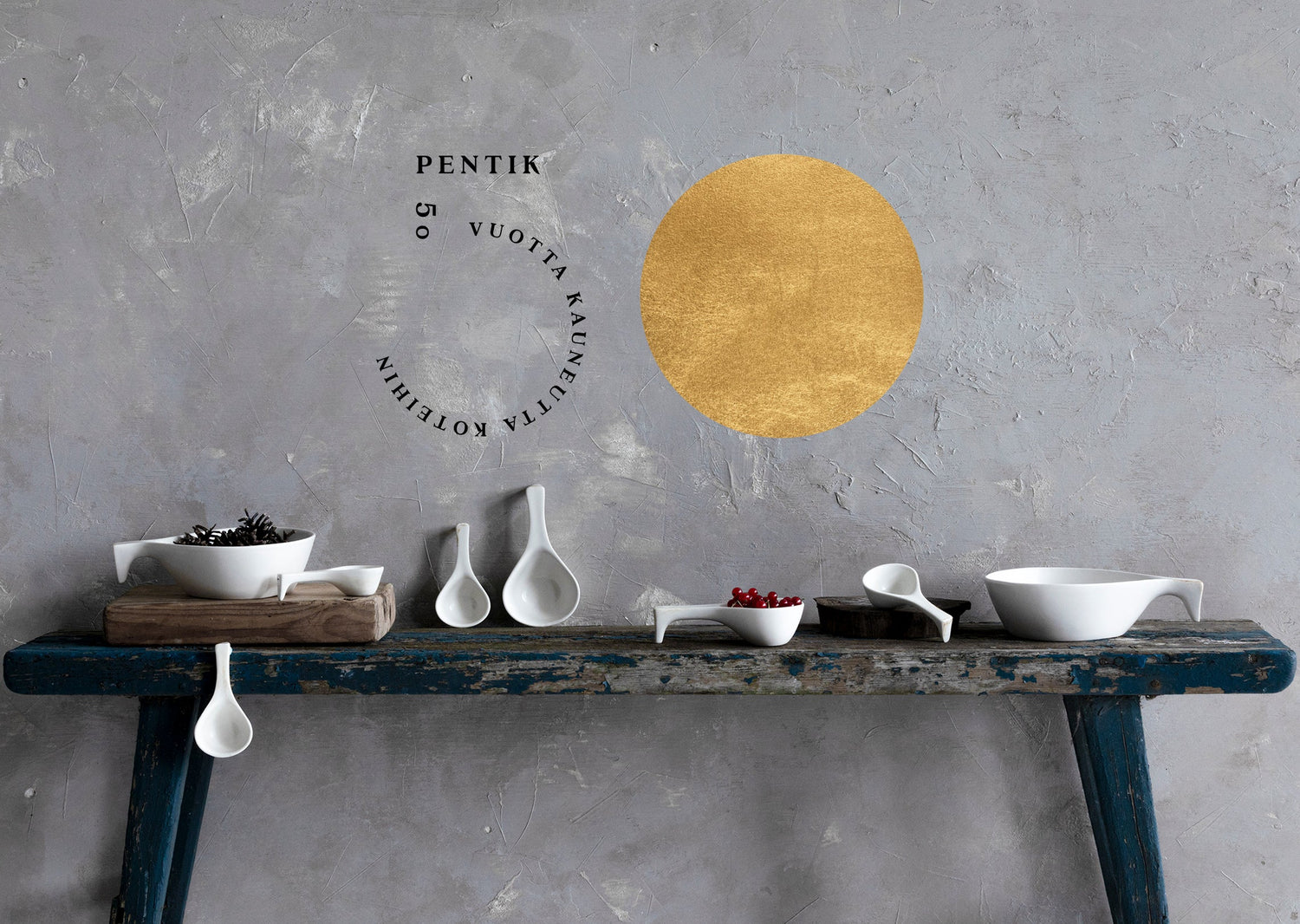
Anniversary year's ceramic Kuksa encourage creativity
Anu Pentik designed the ceramic Kuksa series as a symbol of Pentik's 50th anniversary year, consisting of two cups and a bowl. The product family will be complemented by a mug during 2021. The Pentik Kuksa is a modern interpretation of the traditional Lapland classic made from birch burl and at the same time a tribute to Finnish nature. In the use of the versatile ceramic kuksa, both for everyday and festive settings, only imagination is the limit.
“We proudly present the anniversary year's Pentik Kuksa series and at the same time encourage our product friends to be creative – table settings can be personalized by boldly combining products. By favoring domestic companies and quality products, everyone can act responsibly. Our ceramic items are made to last from generation to generation,” says Pentik's Marketing Director Minna Lampinen.
“Pentik's history is a story of family, friendship, and the power of working together. In honor of the anniversary year, we present stories behind the products, their makers, and the locations. We at Pentik believe that the most wonderful stories are captured in products through their use. That's why we invite all Pentik friends to share their own stories during 2021,” says Minna Lampinen.
 |
 |
 |
 |
Pentik decades in one setting
1970s: Production begins in a home pottery workshop and expands to the manufacture of utility items
The Pentik family ended up in Posio by chance, following the job of newly graduated gymnastics teacher Topi Pentikäinen. In the new home and amidst nature, there was space to think and be oneself. The company started in 1971 from Anu Pentik's home pottery workshop, driven by the young woman's passion for art and belief in her own dream. The first product for sale was the ruggedly beautiful Kaamoskivi (Polar Night Stone) candleholder, which divided opinions but sold out as soon as products were made. Sales, which started at the local Posio Esso, quickly expanded to Finland's most popular department stores. Anu Pentik diversified her production from art to utility items, and entrepreneurship took on new dimensions when the world's northernmost ceramic factory was inaugurated in Posio in 1974. Pentik's first Helsinki store opened on Esplanadi in 1976.
1980s: A time of growth
There was demand for Pentik's household utility items, and the ceramic factory was expanded twice. Alongside ceramics, fashionable leather clothing became another strong business area for the company. In addition, Pentik began manufacturing furniture under the Artzan brand. Pentik was awarded the national entrepreneurship prize in 1986.
1990s: Focusing back on core business
Pentik closes the Artzan furniture factory and leather clothing manufacturing. During the recession years, the focus shifts back to ceramic products, and a bold decision is made to establish a proprietary store chain in Finland. Between 1993 and 1995, stores are opened at a rate of one per month at their peak. The store network comprises a total of 35 stores.
2000s: Generational change in a diverse design house
Home textiles and furniture become part of the family business's offerings at the turn of the millennium. Anu Pentik is given space for art and creative experiments as the company undergoes a generational change. In 2004, Anu and Topi's son Pasi Pentikäinen is appointed Pentik's CEO. In the 2000s, Anu Pentik organizes several art exhibitions and receives numerous recognitions and awards. She is, among other things, promoted to Honorary Doctor of the University of Lapland. The Pentik store chain expands to Sweden, Norway, and Denmark.
2010s: Time of internationalization of the store network
In 2013, the first proprietary store opens in Russia, and between 2016 and 2017, the store chain expands to Utrecht and Prague. Riikka Wulff begins as Pentik's first CEO from outside the family in August 2019. The company's management team is completely renewed during 2019-2020. In addition to Riikka Wulff, the management team includes design and product director Luisa Laine, marketing director Minna Lampinen, HR manager Carola Rahkola, and e-commerce manager Sami Karjalainen.
2020s: Sustainable development guides operations
Pentik's ceramic products are still manufactured in Posio, near the Arctic Circle. Alongside the world's northernmost ceramic factory, there is also a candle workshop that produces domestic candles suitable for seasons. The majority of the company's turnover comes from Design from Finland products, and all products manufactured at the Posio factory have the Key Flag symbol. Production focuses on environmentally friendly operating methods, and waste heat is utilized in the ceramic factory and candle workshop. In 2020, Pentik Hill in Posio receives the Green Key and Sustainable Travel Finland labels as a testament to its valuable and long-term work for sustainable tourism. The responsible and popular tourist destination attracts over 100,000 visitors annually. Pentik celebrates its 50th anniversary. The family business's anniversary year is also Anu Pentik's artist anniversary year, culminating in the "In the Beginning There Was a Seed" exhibition at WAM Turku City Art Museum in June.
Further information about Pentik's anniversary year: pentik.com/pentik50
In our image bank you will find a wide range of photos from 50 years: Link to the image bank
Contact information for media:
Minna Lampinen, Marketing Director
Tel. +358 40 586 8262


